Driving sustainable development through innovative initiatives, capacity building, and community-led action across agriculture, education, environment, and livelihoods.
Explore our 8 integrated programme areas designed to create lasting, measurable impact across Vidarbha's communities — from sustainable agriculture to human development and beyond.
Empowering farmers across Vidarbha's 11 districts with sustainable practices, modern techniques, and direct market access to improve livelihoods.
Our flagship agriculture programme focuses on transforming farming livelihoods across the Vidarbha region. By integrating traditional knowledge with modern agricultural science, we empower farmers to adopt sustainable practices that increase yields while protecting natural resources.
Through Farmer Producer Organisations (FPOs), community field schools, and direct market linkages, we ensure that farmers receive fair prices for their produce while reducing dependency on middlemen. Our maize value chain programme specifically targets the post-harvest gap — adding value at every stage from field to consumer.
Adoption of eco-friendly, climate-resilient farming methods tailored to Vidarbha's agro-climatic conditions.
End-to-end maize chain support — from seed selection and cultivation to post-harvest, processing, and marketing.
Hands-on experiential learning through demonstration plots, peer-to-peer knowledge sharing, and expert facilitation.
Establishing and strengthening Farmer Producer Organisations to improve bargaining power and direct market connectivity.
Soil testing, organic matter enrichment, balanced nutrient management, and crop diversification for long-term productivity.
We follow a rights-based, farmer-centric approach — building community ownership, enhancing local capacities, and integrating gender equity into every agricultural intervention.
We collaborate with ICAR, KVKs, state agricultural departments, NABARD, and international development agencies to leverage expertise and scale our reach.
Measurable improvements in farm incomes, crop yields, soil health indicators, and farmer financial resilience — tracked through rigorous M&E frameworks.
Bridging learning gaps through innovative, inclusive, and community-driven education initiatives for children, youth, and educators in Vidarbha.
Education is the cornerstone of transformative change. Our education programme focuses on bridging learning gaps, improving educational quality, and ensuring every child — regardless of geography or socioeconomic status — has access to meaningful learning opportunities.
From digital literacy hubs in remote villages to intensive teacher training programmes and scholarship initiatives for first-generation learners, we build holistic learning ecosystems that work for every child.
Equipping students and communities with digital skills, online learning tools, and technology access for the 21st century.
Establishing village-level learning hubs that serve as inclusive spaces for children, women, and youth to learn, grow, and thrive.
Continuous professional development for educators — covering pedagogy, digital tools, inclusive teaching, and student-centred approaches.
Financial support and one-on-one mentoring for underprivileged, first-generation learners to complete their education journey.
We integrate activity-based, joyful learning methodologies and digital tools to make education engaging, contextual, and effective for every learner.
Special emphasis on girls' education, menstrual hygiene awareness, and safe school environments to ensure equitable access and retention.
Our education initiatives have been recognised by state education departments and implemented across government and residential schools in Vidarbha.
Protecting and restoring Vidarbha's natural ecosystems through community-led watershed development, soil conservation, and biodiversity programmes.
Vidarbha's ecological fabric is under growing stress from climate change, over-exploitation, and unsustainable land use. Our NRM programme works at the intersection of ecology, community action, and policy advocacy to reverse environmental degradation and build long-term resilience.
From constructing farm ponds and check dams to leading afforestation drives and promoting organic composting, our NRM interventions address the full spectrum of natural resource challenges — always with communities at the centre.
Comprehensive watershed planning with check dams, farm ponds, contour trenching, and runoff management for water security.
Terracing, bunding, organic matter restoration, and erosion prevention to protect and rehabilitate degraded agricultural lands.
Native species plantation, community forest management, biodiversity monitoring, and wildlife corridor protection initiatives.
Community climate adaptation plans, drought-proofing, heat stress management, and early warning system linkages for rural communities.
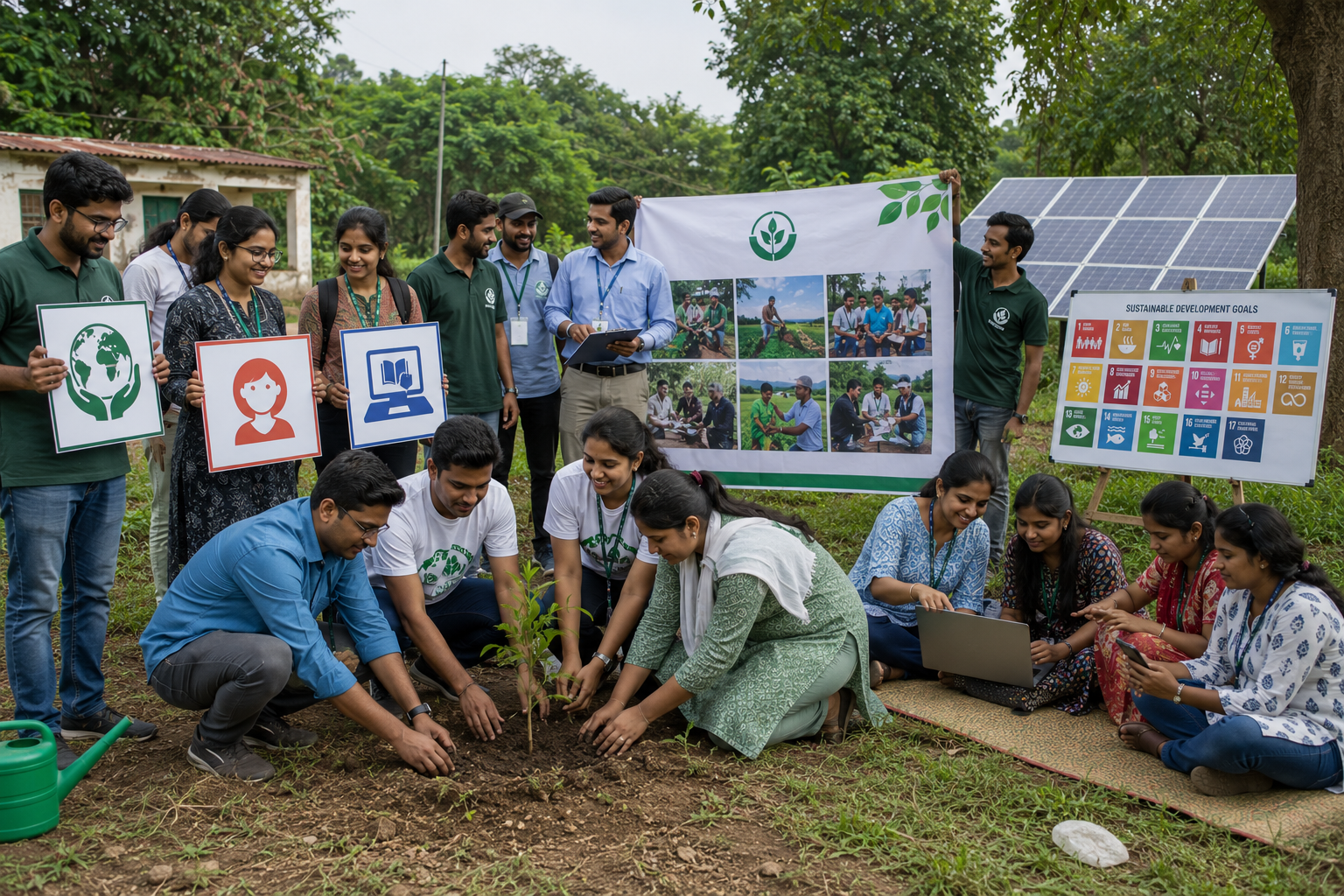
Our NRM work directly contributes to SDG 6 (Clean Water), SDG 13 (Climate Action), SDG 15 (Life on Land), and SDG 2 (Zero Hunger) targets.
Village Water & Sanitation Committees (VWSCs) and community forest committees lead local NRM governance, ensuring ownership and sustainability.
Remote sensing, GIS mapping, and scientific assessments guide our watershed and biodiversity interventions for maximum ecological impact.
Igniting the entrepreneurial spirit of rural communities by building sustainable livelihoods, promoting innovation, and connecting local producers to broader markets.
Rural communities in Vidarbha possess enormous entrepreneurial potential — what they need is structured support, market access, and confidence to unlock it. Our entrepreneurship programme works with women SHGs, youth entrepreneurs, and rural artisans to transform their skills into viable, sustainable businesses.
From business plan development and financial literacy training to access to credit, digital payments, and e-commerce platforms — we provide 360-degree support for rural entrepreneurs at every stage of their journey.
Forming and nurturing Self-Help Groups with governance training, book-keeping, savings habits, and collective enterprise development.
Seed funding support, business incubation, technical hand-holding, and mentoring for small-scale rural enterprises across diverse sectors.
Structured business planning workshops, financial projections, and one-on-one mentoring by domain experts and industry professionals.
Connecting producers to local, regional, and national markets through trade fairs, e-commerce platforms, retail partnerships, and buyer meets.
70% of our enterprise beneficiaries are women — from food processing units and handicrafts to agri-inputs dealerships and tailoring centres.
We help entrepreneurs leverage online marketplaces, social commerce, and digital payments — bringing village products to urban consumers nationwide.
Financial literacy, credit linkage with banks and MFIs, and savings group formation ensure entrepreneurs have the capital they need to grow.
Comprehensive health, nutrition, women empowerment, and social welfare initiatives for holistic community well-being and dignified living standards.
Community health programmes, nutrition awareness campaigns, maternal-child health initiatives, and health camps in villages.
Gender equality, leadership development, economic empowerment, and SHG strengthening for women in Vidarbha.
Child development, social security linkages, community welfare programmes, and rights-based interventions for marginalized communities.
We adopt a leave-no-one-behind approach — ensuring the most vulnerable, marginalised, and underserved communities are reached first and served best.
By integrating human development across all our programme areas, we ensure that agricultural progress, skill development, and entrepreneurship translate into real improvements in quality of life.
Building capabilities, transferring institutional knowledge, and developing professional expertise for sustainable, long-term impact across all levels.
Equipping Vidarbha's youth with vocational skills, career clarity, and placement support to access sustainable employment and self-employment opportunities.
Expert consulting for NGOs, government agencies, and development organisations — from programme design to rigorous impact measurement and institutional capacity development.
Building a cadre of skilled master trainers who can multiply impact at scale — through structured pedagogy, curriculum design, and institutional capacity programmes for lasting knowledge transfer.